Following my Part 1 where I showcased more unusual Perpetual Calendar timepieces, this part will feature the "BIG" pieces... For the first photo essay please click on this link.
The Pateks, AP, Chopard, Moser and Roger Dubuis all feature in this report. Let's start with the most intelligent Perpetual Calendar there is out there - the Moser Perpetual One with the Flash Calendar feature.

First, the fume dial Endeavour Perpetual with a white gold case. For those who know, the minimalist display is ingenious. Unlike "regular" QPs using subdials to display the date and month, the Moser uses a small pointer arrow to indicate the month instead. If that's not ingenious, I don't know what is. Up until then, no watch brand has thought of that.

What's so intelligent about this perpetual calendar timepiece you say? Well, for one the date is a large date window that can be adjusted forward and backward. No worries about over winding - past the date, just set it back. Secondly, the date, month and leap year indication all change in synchrony - one of the few QPs that have this feature.

And the manual winding timepiece comes with 7 days of power reserve. The rose gold version above comes with a black lacquer dial. But unlike most QPs, the adjustment is entirely by the crown, save the one pusher at the 9 o'clock for the leap year advancement.
Next up is the pair of Chopard LUC Lunar One - one in rose gold and another in platinum. Both early versions from the brand.
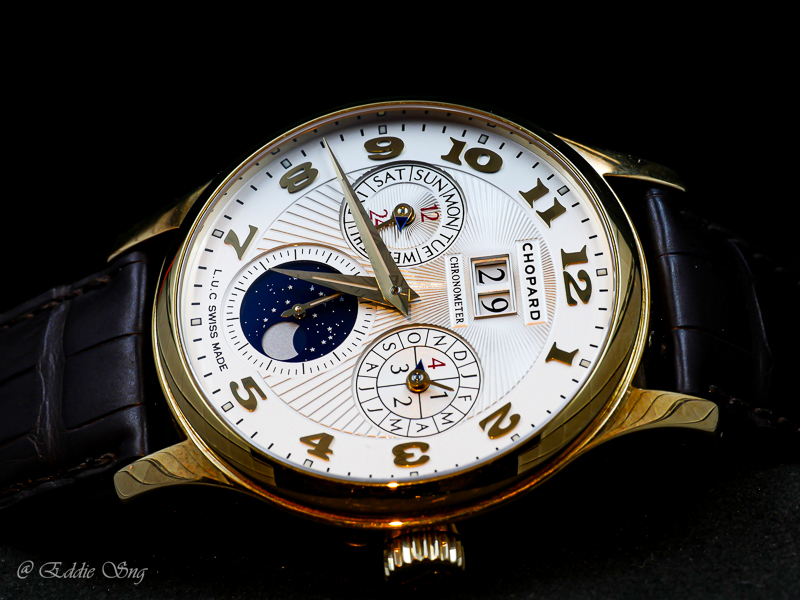

As with the Moser, the Chopard also features an instant jump but has one more complication compared to the Moser - the moonphase indication.


The platinum version of the Lunar One...
At this juncture, we were all starting to discuss the Leap Year indicator - is it supposed to be showing 1 or 4? Lively discussion about how one has made mistakes on the Leap Year indication only to realise it too late after the date has passed... We believe most (if not all) indicators should show 4 with some brands actually having the 4 in red as with the Chopard.


One of the "bigger" piece at the GTG is this Audemars Piguet Royal Oak White Ceramic Perpetual Calendar... While they have released the blue ceramic piece, I find the white ceramic more appealing.

AP did it differently with their Leap Year indication using the letter L instead of the number 4. No confusion here.
Then the three Pateks - reference 5159, 5970 and 5146. Those familar with the references will know what I am talking about. First, another iconic piece - the Nautilus Perpetual Calendar.

As you can see, Patek uses the number 4 to indicate the Leap Year. But who is nitpicking? It's a Patek after all.


Not an everyday watch but definitely one with presence.
Then there is this retrograde beauty - a much more subtle QP.

The use of windows instead of sub-dials make this one more legible.


Property of a discerning gentleman.
The Grand Complication Perpetual Calendar Chronograph - the epitome of any collector's dream.

Perpetual Calendar Chronographs are not norms, hence the name Grand Complication for the 5970.


Even while the display of the 5970 uses sub-dials, the overall legibility is still very good. Grail worthy!
What about this Roger Dubuis Sympathie Bi-Retrograde Perpetual Calendar Chronograph?


Slightly more complicated than the 5970J with the bi-retrograde day and date, the case shape is so difficult to make that later versions came with rounded sapphire instead of one cut out to fit the case shape.

And the beauty is also at the back too...

Then there are two pieces that, while not QPs, are very interesting pieces. The Arnold and Son Luna Magna and the Carl F Bucherer Heritage Bicompax Annual Calendar. Let's start with the Carl F Bucherer annual calendar...

I'm not one for date windows at 4 o'clock but in this case, the window at 4 o'clock displays the month of the year.

Unlike Perpetual Calendars, Annual Calendars do not account for the Leap Year which means one has to adjust every February as the date jumps from 28 to 29 through to 1 March. Other than that, the annual calendar will get the days of the month correct regardless of it being 30 or 31 days. So if one wears it as a daily beater, one only need to adjust in the month of February.


What a moonphase! The Arnold and Son Luna Magna has one of the largest 3D moonphase display in the world of horology.

Magnificent!

The 3D moon is 12mm in diameter with one half of the sphere made of white marble and the other half of aventurine glass. Talk about a watch with presence...
The GTG was fun and for the first time, so many Perpetual Calendars made their appearance and presence felt. Many unusual finds and many big pieces on display. And then there were the 5 MIH Annual Calendars. I was somewhat disappointed no Lange QP made an appearance here - that would have been great.
So which particular Perpetual Calendar caught your eye?


