Throughout my collecting journey, I have never intentionally choosen a particular timepiece just because it was manual winding or otherwise. But oddly enough, my collection has gravitated towards timepieces with manual winding movements.

What are the considerations when choosing a timepiece - for sure, the movement is one of the main consideration. I don't think I have consciously sought a timepiece just because it is manual winding or self winding. But for a geek like myself, the full view of a manual winding movement in its full glory gives me that satisfaction of a well laid out architecture as well as movement finishing. And the winding to give life to the timepiece is a ritual that most of us do with great pleasure - that tactile feel.

For chronograph, I personally prefer the manual winding movement. For instance, both the Lange 1815 Chronograph (above) and the Montblanc Villeret 1858 Vintage Pulsographe (below) featuring the Minerva movement have such a nice movement layout and the finishing on the movements are sublime.

Ask any collectors and most will tell you the Lange 1815 Chronograph or the Datograph movement is to die for. The depth and construction of the manually wound calibre L951.1 for the first gen Datograph is the gold standard.

What about self winding movements?
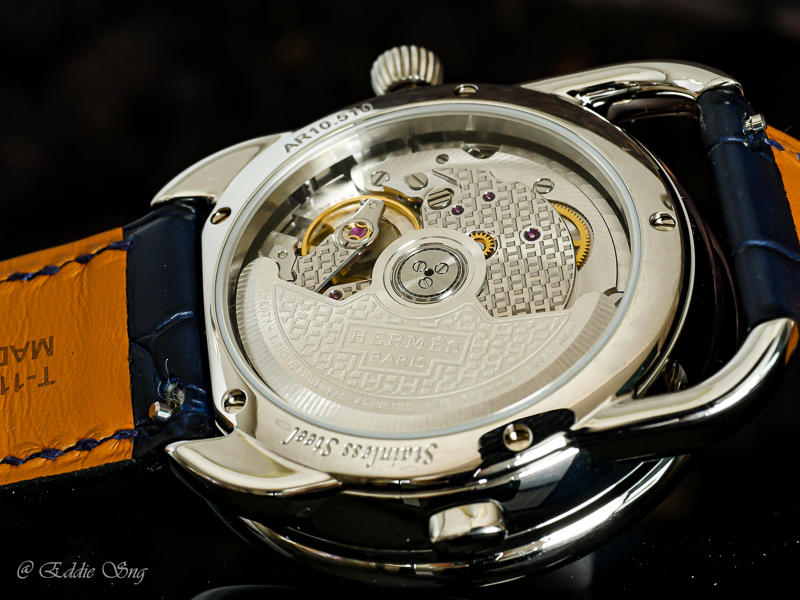
While there are benefits to having a self winding movement, like the convenience of not having to wind the movement, the view at the back is less appealing, at least for me.

The rotor placement and the size of the rotor obscures part of the movement. To many collectors, half the fun is the ability to be able to see the movement and admire the bridges and finishing of the movement. Imagine such a well finished movement like the one below, the Glashutte Original Senator calibre 36-01... unfortunately, the rotor covers parts of the movement.

Well, that's traditionally true - the obscuring of the movement by the rotor. In come this invention called micro-rotor...

With the micro-rotor, the fact that the rotor sits on the same plane as the main bridge gives us an unobscured view of the movement. Combining fully visibility with the convenience of an automatic calibre. But some will argue the efficiency of the winding mechanism is not as productive as a full rotor.

Take a look at the micro-rotor on the Chopard LUC Lunar One Perpetual Calendar.

The inclusion of the micro-rotor opens up the whole movement, exposing the entire main bridge and the finishing on the bridges... Wow!

Perhaps the micro-rotor is a go-between. A good one at that.
But for now, I think the manual winding calibres are awesome. Take a look at this Roger Dubuis Sympathie Bi-Retrograde Chronograph Perpetual Calendar. Gorgeous movement...

What about the iconic Lange 1?

Or the Duometre range from Jaeger leCoultre...


And a hark back to vintage... the IWC Poruguese Jubilee reference 5441

And the Armin Strom is another beauty... What's nice about the Tribute 1 is that the watch comes with 5 days of power reserve on one full wind.

And if 5 days of power reserve is not enough, what about 7 days of power reserve on the Moser Perpetual One?

Or the Parmigiani Hebdomadaire? 8 days!

Even the "simpler" UNITAS movements can be well decorated beyond recognition. Take a look at these two examples... First the Pascal Coyon Chronometer

And the Felipe Pikullik ZMB1. Both redesigned and finished to the highest level...

Or the Corum Golden Bridge

I think my preference is clearly favouring the manual winding movement pieces. Like I said, I did not intentionally start out that way but along the way, my preference has become quite clear.
I guess there is no right or wrong - it's personal preference at the end of the day. So, what's yours preference? Manual winding or automatic?


