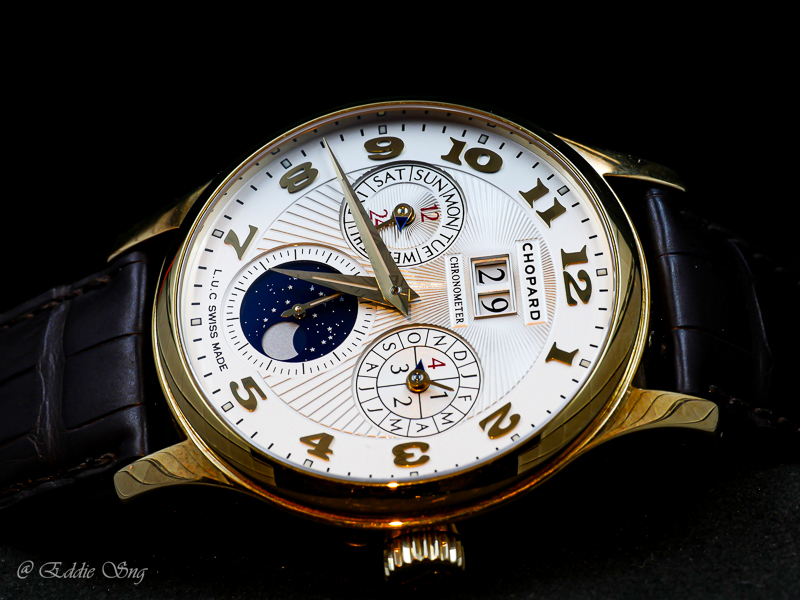
So, there is the traditional perpetual calendars with their sub-dials like the Roger Dubuis Sympathie Chronograph Perpetual Calendar Biretrograde and then there is the H Moser Perpetual Calendar with their minimalist display but highly technical movement. Now, we explore the “in-between” – the Chopard Lunar One Perpetual Calendar.
Perpetually Yours
After exploring the understated brilliance of the Moser Perpetual 1, it feels only natural to turn to another perpetual calendar that shares a similar philosophy, yet expresses it in an entirely different approach: the Chopard L.U.C Lunar One Perpetual in platinum. Where the Moser is minimalist and almost rebellious in its restraint, the Lunar One is classical, composed, and deeply Genevan in character – a perpetual calendar that wears its complexity with quiet confidence.

The Chopard L.U.C Collection
To understand the Chopard L.U.C Lunar One Perpetual, one has to understand the Chopard L.U.C Collection. At its core, L.U.C stands for Louis-Ulysse Chopard, the founder of the maison, and the line represents the brand’s highest expression of haute horlogerie.

Unlike most Chopard watches – which are often stylish, well-made, and reputable – the L.U.C collection is fully in-house manufacture: every movement is designed, developed, produced, finished, and assembled under Chopard’s supervision in Fleurier, Switzerland. This places L.U.C in a different league compared to Chopard’s more mainstream offerings that rely on external calibre suppliers or modular movements.
The Origins & Their Philosophy
An often-overlooked detail in Chopard’s history is that the family’s origins lie in beekeeping, a quiet but fitting metaphor for the values that would later define the L.U.C manufacture. This heritage found its way into some of the early L.U.C watches, where solid casebacks were engraved with beehives – a symbol of patience, precision, and collective craftsmanship.

Much like a beehive, these early L.U.C movements were conceived as systems where every component worked in harmony, unseen but essential. While modern L.U.C pieces now reveal their movements through sapphire casebacks, the beehive motif remains a subtle reminder that Chopard’s pursuit of haute horlogerie has always been rooted in discipline, structure, and long-term thinking rather than spectacle.

The Qualité Fleurier Certification
While the L.U.C Lunar One Perpetual is not certified under the Qualité Fleurier (QF) standard, it is impossible to discuss Chopard’s technical philosophy without acknowledging this little-known but deeply respected hallmark. Co-founded by the three brands in Fleurier – Chopard, Bovet, and Parmigiani Fleurier, the Qualité Fleurier certification was conceived as one of the most demanding standards in Swiss watchmaking – not only assessing movement finishing, but also real-world performance.

Unlike seals that focus primarily on decoration, QF requires a watch to pass COSC chronometer testing, demonstrate exceptional finishing, and crucially, survive the Chronofiable test, which simulates several years of actual wear. The watch must also prove its accuracy once fully cased, not merely as a bare movement.

That the Lunar One does not carry the QF hallmark does not diminish its stature; rather, it highlights Chopard’s broader watchmaking credibility. The existence of the Qualité Fleurier standard underscores the brand’s long-standing commitment to durability, precision, and honesty in horology – values that clearly inform the engineering of the L.U.C perpetual calendar, even when a different certification path is chosen. For collectors, QF serves as a reminder that Chopard’s ambitions in high watchmaking extend beyond aesthetics or marketing, grounding the L.U.C range in a culture of real mechanical accountability.

In-House Calibres
L.U.C watches use in-house calibres developed by Chopard’s manufacture – true haute horlogerie engines, such as the L.U.C 96 series, 01.01-L, 03.10-L, 08.01-L, and others.
These in-house movements boast features rarely seen at the same price tier:
- Twin barrels & long power reserves (e.g., 65–70+ hours)
- Geneva Seal / Chronometer certifications
- Complications executed at the highest mechanical level

One of the defining technical highlights of the Lunar One is its instantaneous date jump, a feature still surprisingly rare among perpetual calendars. At midnight, the large date advances crisply and decisively, a satisfying reminder of the mechanical discipline beneath the dial’s calm surface. This instantaneous change is not merely aesthetic; it reflects the robustness and precision of Chopard’s in-house L.U.C Calibre 96.13-L, a movement that combines technical sophistication with long-term reliability – no small feat in a QP with a large date and moonphase complication.
The Calibre 1.96QP
At the heart of the Chopard L.U.C Lunar One beats the manufacture Calibre 96.13-L, a movement that blends technical sophistication with refined execution – one of the most thoughtful perpetual calendar mechanisms in modern haute horlogerie.

Where the Lunar One truly distinguishes itself, however, is in its movement and the finishing. Chopard’s L.U.C manufacture has long been one of haute horlogerie’s best-kept secrets, and this watch is a prime example. From the meticulously decorated bridges to the finely executed anglage and Geneva Seal certification, the movement finishing rivals – and in some respects surpasses – far more publicly celebrated names. It is the kind of finishing that rewards time spent under a loupe, revealing layers of care and intent rather than mere compliance with standards.
In-House Manufacture Design
Unlike many perpetual calendar calibres that rely on modified base movements, the Calibre 96.13-L is fully developed within Chopard’s Fleurier manufacture. Every gear, bridge, and interaction is conceived with the perpetual calendar architecture in mind, which translates into a movement that feels cohesive rather than patched together.
Microrotor Winding — Elegance Meets Efficiency

One of the most distinct features of this calibre is its microrotor automatic winding system. Instead of a centrally mounted oscillating weight:
- A compact microrotor is built directly into the movement plane, often in solid gold for optimized mass and winding efficiency.
- This ingenious placement allows the movement’s architecture to remain visually open — an important trait for collectors who appreciate movement aesthetics as much as functionality.
- The microrotor winds twin barrels, which work in series to deliver a more stable and consistent power flow to the escapement and calendar mechanisms.
The microrotor doesn’t just look elegant – it enhances mechanical harmony, reduces overall thickness, and brings a refined sense of balance that traditional rotors often hide.
Instantaneous Date Jump
One of the Lunar One’s most satisfying mechanical traits is its large date display with an instantaneous jump at midnight. This means:

- At precisely 00:00, both discs advance simultaneously in a crisp and decisive motion.
- There is no slow transition over hours – a feature often found in simpler calendar watches – but rather an immediate shift that underscores the movement’s engineered precision.
This instantaneous action is not trivial; it requires finely tuned energy release and lever geometry to ensure accuracy and reliability over long periods.
Highly-Accurate Moonphase
The moonphase complication on the Lunar One is not merely decorative: it’s astronomically precise, designed to deviate by only one day every 122 years when adjusted correctly. This level of accuracy is achieved through careful ratio calculations in the gear train and reflects Chopard’s respect for both mechanical integrity and functional artistry.

For many perpetual calendar aficionados, this moonphase execution places the Lunar One in the same conversation as top high complications that prioritize true celestial performance over simple visual interpretation.
Twin Barrels for Stable Power
The architecture uses two stacked barrels operating in series, which delivers two key benefits:
- Extended power reserve — often exceeding 65 hours, even with the calendar and moonphase actuators engaged.
- Stable torque delivery throughout the reserve range, which is critical for maintaining both timekeeping accuracy and reliable calendar changes.

The result is a movement that doesn’t merely function — it feels robust and dependable on the wrist.
Finishing & Haute Horlogerie

Although this Lunar One example does not carry the Qualité Fleurier seal, the Calibre 1.96QP is Geneva Seal certified, meaning:
- Hand-bevelled edges
- Côtes de Genève across bridges
- Perlage on base plates
- Thermally blued screws and polished steel components
- Gold chatons where appropriate

This finishing is not surface-level – it extends across every functional component, giving the movement a degree of refinement that rewards inspection under a loupe. I had the pleasure of meeting Ms. Caroline Scheufele and she proudly proclaimed that all L.U.C. timepieces are finished to the highest level and even surfaces hidden from view are also finished.

The Movement In Essence
The Chopard L.U.C Lunar One movement stands out because it weaves together:
- Architectural beauty (microrotor visibility)
- Mechanical precision (instantaneous date jump)
- Astronomical finesse (accurate moonphase)
- Stable performance (twin barrels)
- Haute horlogerie finishing (Geneva Seal execution)
It’s a movement that isn’t just engineered — it’s curated, and that makes it a compelling chapter in the story of modern perpetual calendar design.
That Dial Layout and Legibility

Visually, the Lunar One strikes a masterful balance between legibility and density. The dial layout is symmetrical and intuitive: day and month indications framed cleanly, a beautifully rendered astronomical moonphase at six o’clock, and the oversized date anchoring the composition.

The month and Leap Year indicator.

The day and 24-hour indicator.
Despite the amount of information presented, nothing feels crowded. The platinum case lends the watch a subtle gravitas – never flashy, but unmistakably substantial in hand – perfectly suited to the L.U.C ethos of discreet luxury.

In Conclusion
Seen alongside the Moser Perpetual 1, the Lunar One highlights just how diverse the perpetual calendar complication can be. Both watches share an emphasis on mechanical integrity and instantaneous calendar change, yet their personalities could not be more different. The Moser speaks in a modern, minimalist whisper; the Chopard responds with classical eloquence and artisanal depth. For collectors who appreciate perpetual calendars not as statements, but as long-term companions, the L.U.C Lunar One Perpetual stands as one of the most complete and quietly compelling expressions of the complication available today.
Visit my blog on my write up on the Roger Dubuis Sympathie Chronograph Perpetual Calendar Biretrograde and compare all three Perpetual Calendars. Which one do you like? Drop me a comment.