Following on my initial photo essay on the Leap Year GTG, here's the slightly more detailed scoop of the timepieces on display.
And what a variety on display - 3 Pateks, 2 Mosers, 2 Ulysse Nardins, 2 Chopard LUCs, 1 Audemars Piguet Royal Oak and many many more you probably have not seen or even know of its existence. Such is the diversity of collectors in the group which is what I love about this group of collectors.
Let's start with the revitalised Alain Silberstein and in this case, the Pikto Smileday - Le Perpetuel - Automatique. Made in a limited edition of 100 examples in the 1990s, this was for the Japanese market.

What an unusual QP - every interval represents 5 minutes which means this picture shows 7:15 (or thereabouts), based on red pointer triangle ala single handed watch. The circular pointer is the date, the yellow squiggly hands the central seconds and the hand with the blue square being the counter balance. What a fun perpetual calendar to have - IYKYK... The QP display module is on the back which is why I will take time to photograph that

Next up, another lesser seen brand, let alone a Perpetual Calendar - the DeWitt. The version is called the DeWitt Academia Quantieme Perpetual Bi-Retrograde.


Next up is this Union Glashütte 39mm Tradition Perpetual Calendar.

This stainless steel automatic piece features the Union calibre 26-50 providing about 40 hours of power reserve. Notice the day sub-dial is in German and not English.

And while the Ulysse Nardin Perpetual Ludwig is not unknown, what's amazing about this piece is the fact that it was first created in 1996!

What's so special about this perpetual calendar? Well, for one, the adjustment is done by the crown without the pushers to boot.

Then there is the large date window and the 2 year digital year display. But what sets this QP apart from others is the fact that you can wind and adjust the date not only forward, but also backward. Yes, this was the first QP that allowed their owner to wind backwards if they over-wind their timepiece. All other QPs at that time could only adjust forward and should you move beyond the current day/date, you would have to let the watch stop and allow time to catch up or worse still, send it back to be adjusted.

Such is the case of the IWC Da Vinci Perpetual Chronograph. Developed by Dr. Kurt Klaus in the 80s (yes, that's how long ago it was) the multi-step program disc is adjusted via the crown. No pushers!

It was THE only perpetual calendar featuring a 4 digit year display and one without pushers with the complication adjusted fully by the crown. But it does have a disadvantage though... The timepiece can only be adjusted forward and if one over winds, then you have to allow the watch to stop and for time to catch up. Additionally, this is also a very sensitive timepiece - adjustment via the crown has to be done slowly. Wind too fast and if the discs mis-aligns, service centre here I come!

And one cannot speak of IWC without mentioning Richard Habring of Habring. Coming from the Chrono-Felix family of watches, this Perpetual Calendar is as handsome in picture as it is in metal.

Not only does it feature a chronograph, it is a monopusher no less. Case is a very wearable 38.5mm and it is a manual winding timepiece with about 48 hours of power reserve.

The Citizen Chronomaster Iconic Nature Collection features 4 limited edition Eco-Drive Perpetual Calendar - one representing each season of the year.

The dial is made with the world’s thinnest washi paper. Seen here is the Spring Air model (AQ4100-06W) featuring a green dial representing new leaves of the spring season. With an accuracy rate of 5 seconds per annum, it is probably the most accurate perpetual calendar in the world.
Well, it wasn't just watches on display - we had good food too at XiYan Maxwell. While it was just past Chinese New Year, we still started with the Lo Hei salad toss...

To good health and prosperity! Huat Ah!!!

Back to regular programming :-)

Not quite the QP, the Annual Calendar is also an interesting complication. Unlike the perpetual calendar, the owner will have to adjust the date/day in the month of February. For the rest of the year, the numbers of days will adjust itself. One of the most well known annual calendars out there is the MIH Annual Calendar.

Developed by Dr. Ludwig Oechslin (formerly from Ulysse Nardin) when he was the Curator of the Museée International d‘Horlogerie (MIH) in La Chaux-de-Fonds, the annual calendar is built on the sturdy ETA7750 ebauche with a stcaked on module. Not only is it an annual calendar, it is also a monopusher chronograph. Launched in 2005, the last piece was sold in 2020.

On show at our GTG were 5 examples of the MIH Annual Calendar watch. There could have been more but some did not read the memo :-)
Speaking about not reading the memo, a few interesting annual calendars did show up and I could not leave them out of the line up. First up the Patek reference 5146J.


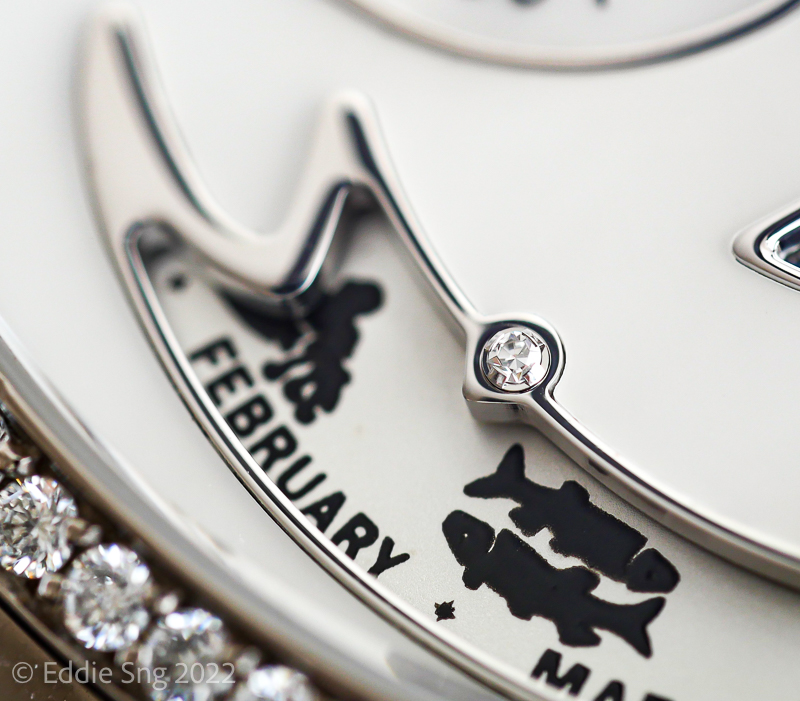
And the Girard Perregaux Cat's Eye Zodiac Annual Calendar.

Look closely at the window at the bottom of the case, you will be able to see the Zodiac display representing the month of the year. This particular example belongs to my wife and is one of her favourite timepieces.
More to come in Part 2 of this coverage... the big guns come out to play! Stay tuned...